
Your needs, this model
Does it fit your priorities?
Is the current Fairway C described for walking?
Yes. Callaway calls this a stand bag and describes it as designed for a premium walking experience, with an ANAMATIC strap and Parabolic Hip Pad. That is manufacturer positioning, not an independent comfort or body-fit test; no cart-specific interface is documented on this page.
Explore this need in the finder →What does the four-way top mean for separation?
The exact current page lists a 4-way Shaft Shield top and four full-length dividers. The published layout therefore meets a minimum of four top dividers and explicitly says the dividers extend full length. It does not establish a particular club or oversized-grip fit.
Explore this need in the finder →Does its listed 4 lb weight meet a 4 lb empty-weight limit?
Not as documented. Callaway lists Weight: 4 lb but does not label that number as empty weight or clarify whether accessories are included. Because the finder asks for a confirmed empty-bag ceiling, this record leaves that field unknown rather than treating the listing as a qualifying 4 lb empty weight.
Explore this need in the finder →A four-way walking bag, not a cart-first organizer
The current Fairway C is Callaway's compact stand-bag direction: a four-way Shaft Shield top, four full-length dividers, a stand system, a listed eight pockets and a strap-oriented description that explicitly targets walking. Its strongest documented case is for someone who wants a straightforward, four-section club layout and a lighter category of bag without trading down to a pencil-style model. The exact U.S. product page does not describe a cart strap channel or a cart-use arrangement, so this assessment treats walking as the supported plan and leaves cart capability unclaimed.
Four full-length dividers separate more of the club shafts than a top-only partition statement would establish. That is a real distinction in the page evidence, but it is not a guarantee that every grip size or club combination will slide easily: top openings and grip dimensions vary, and Callaway does not provide a grip-fit chart. A four-way layout also keeps the opening simple rather than giving each club an individual lane. Buyers who already know they want fourteen individually separated clubs should compare a fourteen-way model instead of reading “Shaft Shield” as a substitute for a different divider count.
Current strap and stand details
Callaway describes the current Fairway C as engineered for a premium walking experience and lists its ANAMATIC strap with a Parabolic Hip Pad. Those are manufacturer descriptions of design intent, not a measured balance result or proof that the strap geometry suits a particular golfer. The exact page does not say whether this version includes a single strap, a convertible pair, or a specific adjustment range; do not assume the older Fairway C '24 strap configuration is unchanged. The FLEX POD base and stand-bag identity establish a stand setup, but no independent deployment or stability test was performed for this review.
Likewise, the page's naming of a stand bag does not establish a cart-strap pass-through. There is no identified cart channel, strap access route, or cart compatibility statement on the product evidence used here. A shopper who expects to ride or push most rounds should confirm how straps, legs and pockets sit on their actual cart before treating it as dual-purpose. In the finder, this exact model qualifies for walking; it does not qualify for cart or both-use requests simply because its stand may be folded.
Storage and the listed weight need careful reading
Callaway lists eight pockets, which gives a count but not their aggregate volume, dimensions or organization. The exact feature block names the pocket count without an overall capacity figure. That can help a buyer compare the number of separate storage openings, but it cannot answer whether a particular rain layer, valuables pouch, rangefinder or bottle fits. The page also gives no waterproof rating or explicit rain-hood inclusion statement. Check the exact package and pocket layout if those details are requirements rather than nice-to-haves.
The product specification lists “Weight: 4lbs.” The page does not expressly label that figure “empty,” explain what removable pieces it includes, or describe a weighing method. It is retained here as Callaway's listed bag weight, not a tested measurement or a confirmed empty-bag value. That distinction matters: the site's numeric filter asks for a maximum empty weight, so this Fairway C does not pass a hard numeric limit on the present evidence, even when the entered limit is 4 lb or higher. If a published empty-weight ceiling is essential, verify that basis with the manufacturer or retailer before choosing.
The same product page lists a polyester body and dimensions of 36 inches high by 7 inches wide by 12 inches deep. These are manufacturer specifications, not measured clearances or a promise that the bag fits a particular trunk, storage rack or cart. The height is worth checking against a golfer's own vehicle and storage constraints; the page does not identify a collapsed or folded dimension.
How it differs from the earlier Fairway C '24
Callaway shows the current Fairway C separately from the Fairway C '24. Both pages list a four-way top, eight pockets and a 4 lb figure, but those similarities do not make them the same configuration. The current page explicitly states four full-length dividers and names the ANAMATIC strap plus Parabolic Hip Pad. The older page describes ANAMATIC double straps and a FLEX POD base, while its inspected description does not say that the divider walls run full length. Only the newer page used for this assessment states the dimensions and polyester material. Missing older-page details remain unknown rather than being filled from the current model.
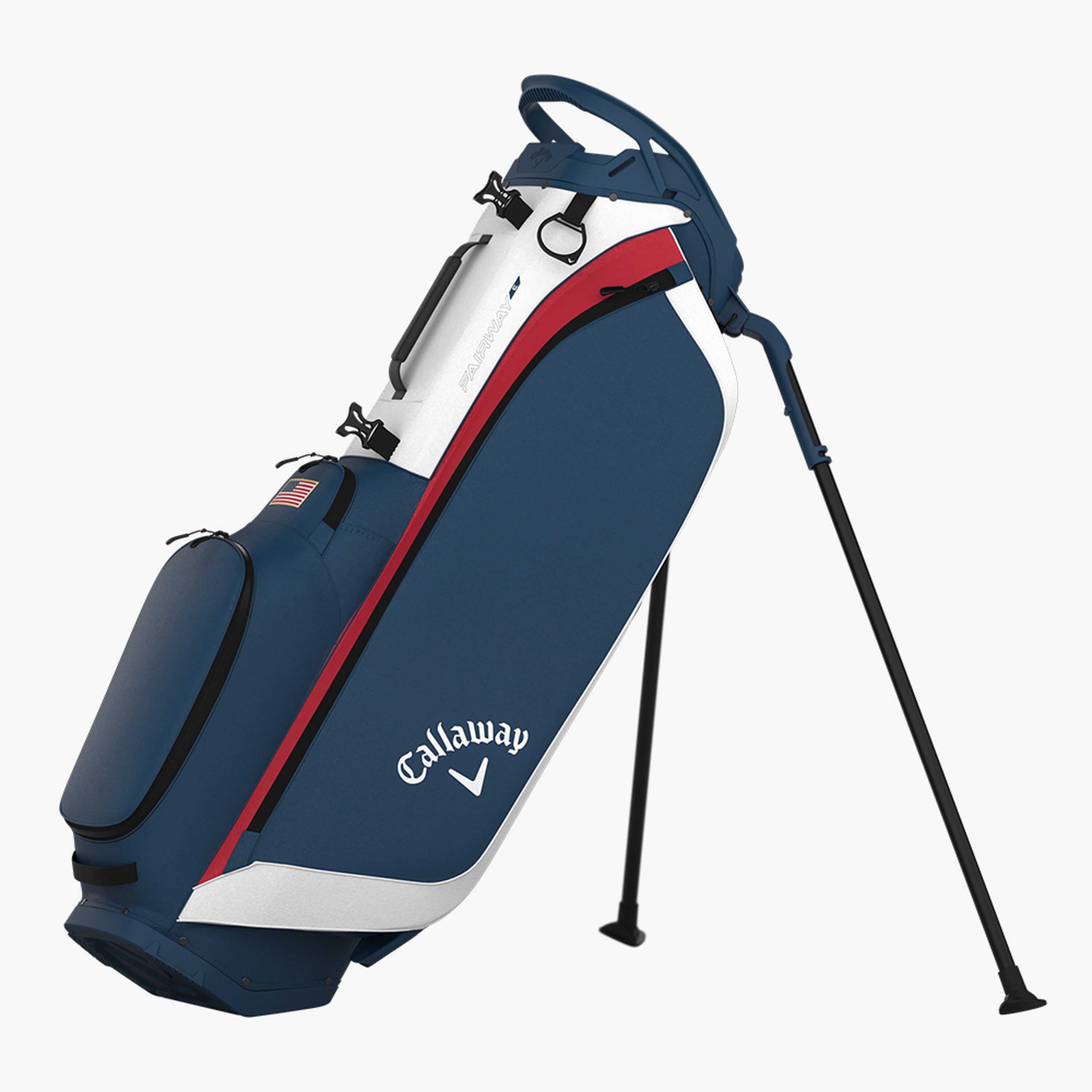
The manufacturer page's selector ID and color swatches are not child SKU evidence. The image shown here is the exact official White/Marine/Red Flag finish selected on the current product page; it establishes appearance, not a performance claim. Other listed finishes should be checked against the exact offer. There is no basis here for asserting that color alone changes the functional configuration, nor for inventing a particular child SKU.
Who should shortlist it—and what to verify
Shortlist the current Fairway C when a four-way, explicitly full-length top and a walking-oriented strap system are the practical priorities. Compare its organization with fourteen-way bags and its manufacturer-listed 4 lb with models whose empty weight is explicitly documented; the current evidence cannot settle that numeric comparison. Do not treat the eight-pocket count as liters of storage, assume a rain hood is included, or infer cart performance from the stand label.
Before ordering, check that the listing says Fairway C without the '24 suffix, confirm your finish and exact package, ask whether the quoted weight is empty-bag weight if that ceiling is important, and compare the listed dimensions with your storage space. If you intend to ride, inspect the bag's strap route and leg clearance on your cart rather than relying on a general product name. This is a source-based assessment of published specifications; it does not claim ownership, hands-on use, durability testing, walking comfort, weather testing, or a fitting session.
Key specifications
Key details at a glance
| Bag category | Carry/stand bag |
|---|---|
| Top divider layout | 4-way top |
| Pocket count | 8 |
| Listed body material | Polyester |
Use the exact model’s instructions for operating limits, supplied equipment and version differences.
Sources for this review
Sources for this assessment
See whether this setup fits your round
Compare the bag's documented configuration with your walking, cart, divider and storage needs; then verify the exact finish and package with the seller.